Uji aktivitas antibakteri ekstrak jerami bawang merah dengan pelarut metanol terhadap bakteri Escherichia Coli secara In Vitro
Abstract
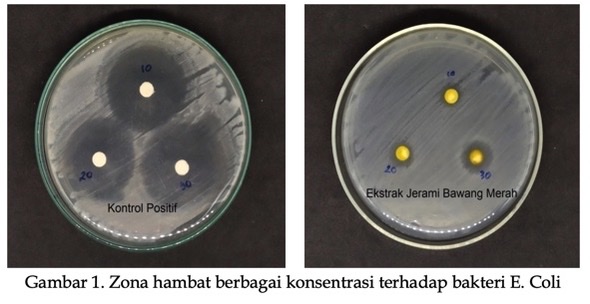
The development of livestock businesses is often hampered by diseases caused by bacteria, one of which is the Escherichia Coli bacteria. One of the compounds that can ward off bacteria is flavonoids. One of the plants that contain flavonoids is shallots. The flavonoids in shallots are able to kill bacteria by denaturing bacterial cell proteins and lysing the cytoplasmic membrane. It is alleged that waste from shallots, namely shallot straw, also has potential as a natural antioxidant and antibacterial. This aims to determine the antibacterial activity of shallot straw extract with methanol solvent on Escherichia Coli bacteria. The research used two stages, the first stage was extracting shallot straw using methanol solution, the next stage was testing antibacterial activity using the disc diffusion method. The study used a completely randomized design with different concentrations of shallot straw extract (10%, 20%, and 30%). Optimum conditions to inhibit E Coli bacteria are at a concentration of 30% with an inhibition zone of 12.82 mm
References
CLSI. 2016. Performance Standards for Antimicrobial Susceptibility Testing. 26th ed. Wayne: Clinical and Laboratory Standards Institute. 32 pp
Farida, R., Dewa, M., Titis, N., Endrawati. 2010. Manfaat Sirih Merah (Piper crocatum) Sebagai Agen Anti Bakterial Terhadap Bakteri Gram Positif dan Gram Negarif. Jurnal Kedokteran dan Kesehatan IndonesiaI. 1(1).
Fatisa, Y. 2013. Daya Antibakteri Ekstrak Kulit dan Biji Buah Pulasan (Nephelium mutabile) terhadap Staphylococcus aureus dan Escherichia coli secara In Vitro. Jurnal Peternakan. 10(1): 31 – 38
Galavi A, Hosseinzadeh H, Razazi B. 2021. The effects of Allium cepa L. (onion) and its active constituents on metaboli syndrome: A review. Iran J Basic Med Sci. 24:3–16
Hosea Jaya Edi, Meilani Jayanti, Edy Parwanto. 2022. Pemanfaatan Bawang Merah (Allium cepa L) sebagai Antibakteri di Indonesia. Pharmacy Medical Journal. 5(1): 27 – 35
Jawetz, Melnick, Adelberg. 2008. Mikrobiologi Kedokteran. Edisi 23. Diterjemahkan oleh Hartanto. H, Rachman, C., Dimanti. A, dan Diani. A, Buku Kedokteran EGC. Jakarta.
Kolenda R, Burdukiewicz M, Schierack P. 2015. A systematic review and meta-analysis of the epidemiology of pathogenic Escherichia coli of calves and the role of calves as reservoirs for human pathogenic E. Coli. Frontier in Cellular and Infection Microbiology. 5:23
Memar, M. Y, Raei, P, Alizadeh, N, Aghdam, A., M., Kafil HS. 2017. Carvacrol and thymol: Strong antimicrobial agents against resistant isolates. Rev Med Microbiol. 28(2):63–8.
Misna., Diana K. 2016. Aktivitas Antibakteri Ekstrak Kulit Bawang Merah (Allium Cepa L.) Terhadap Bakteri Staphylococcus Aureus. Galenika Journal Of Pharmacy. 2(2): 138-144.
Ngajow, M., Abidjulu, J., dan Kamu, V.S. 2013. Pengaruh Antibakteri Ekstrak Kulit Batang Matoa (Pometia pinnata) terhadap Bakteri Staphylococcus aureus Secara In Vitro. Jurnal MIPA UNSTRAT. 2(2), 128-132
Octaviani M., Fadhli H., Yuneistya E. 2019. Uji Aktivitas Antimikroba Ekstrak Etanol dari Kulit Bawang Merah (Allium cepa L.) dengan Metode Difusi Cakram. Pharmaceutical Sciences and Research. 6(1) : 62 – 68.
Pelczar, M.J., E.C.S. Chan. 1988. Dasar-Dasar Mikrobiologi. Universitas Indonesia Press. Jakarta.
Poeloengan, M., Andriani, Susan, M.N., K. Iyep, dan H. Mirza. 2007. Uji Daya Antibateri Ekstrak Etanol Kulit Batang Bungur (Largerstoremia speciosa Pers) terhadap Staphylococcus aureus dan Escherihia coli secara In Vitro. Seminar Nasional Teknologi Peternakan dan Veteriner. 776 – 782
Sa’adah, H., Supomo, Musaenah. 2020. Aktivitas Antibakteri Ekstrak Air Kulit Bawang Merah (Allium cepa) terhadap Bakteri Propionibacterium acnes. Jurnal Riset Kefarmasian Indonesia. 2(2): 80 – 88
Siahaan, I.Y., Nasution, H.M., Nasution, M.A., Rahayu, Y.P. 2023. Uji Aktivitas Antibakteri Fraksi N-Heksan Kulit Bawang Merah (Allium cep) terhadap Bakteri Strptococcus mutans. Journal of Pharmaceutical and Science. 6(4): 1553 - 1560
Steel RGD, & Torrie JH. 1993. Prinsip dan Prosedur Statistika. Ed ke-3. Sumantri B, penerjemah. Jakarta (ID): Gramedia. Terjemahan dari: Principles and Procedures of Statistic: A Biometrical Approach
Syahrina S, Asfianti V, Gurning K, Isen I. 2020. Phytochemical Screening and Anti-Hyperuricemia Activity Test In Vivo of Ethanolic Extract of Shallot (Allium cepa L Skin. Borneo J Pharm. 3:146–51.
Wairata J, Sukandar E., Fadlan A, Purnomo A., Taher M, Ersam T. 2021. Evaluation of the Antioxidant, Antidiabetic, and Antiplasmodial Activities of Xanthones Isolated from Garcinia forbesii and Their In Silico Studies. Biomedicines. 9(10)