Keanekaragaman serangga pengunjung bunga pisang pada beberapa ketinggian tempat di Sulawesi Tengah
Abstract
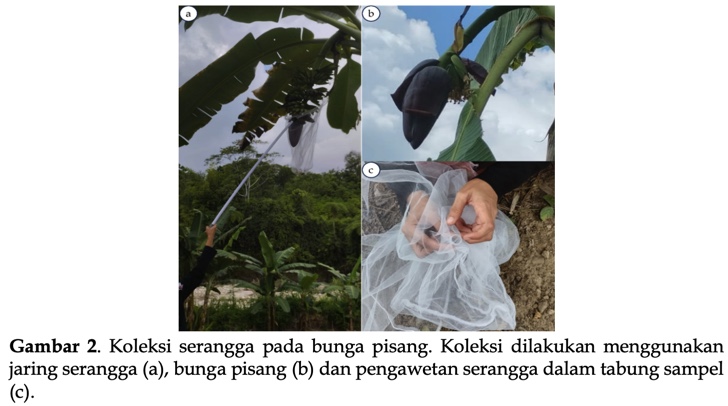
Serangga pengunjung bunga pisang adalah salah satu agen penyebar penyakit Blood Disease Bacterium (BDB). Penelitian ini bertujuan untuk mengetahui jenis dan keanekaragaman serangga pengunjung bunga pada bunga tanaman pisang di Sulawesi. Koleksi dilakukan di enam desa yang dipilih berdasarkan perbedaan ketinggian yaitu Desa Tulo yang berada di ketinggian 52 meter di atas pemukaan laut (m.dpl), Ds. Bobo (767 m.dpl), Ds. Bunga (623 m.dpl), Tongoa (957 m.dpl) dan Ds. Dongi-dongi (1.203 m.dpl). Sampling serangga pengunjung bunga menggunakan alat jaring serangga dengan durasi pengambilan sampel dua kali seminggu selama sebulan, dan dilakukan pada pagi, siang dan sore hari. Serangga yang diperoleh, dicatat dan diidentifikasi di laboratorium. Hasil yang diperoleh yaitu sebanyak 13 jenis serangga pengunjung bunga pisang yang termasuk dalam 4 ordo, 10 famili. Keanekaragaman serangga dari lima lokasi penelitin masih termasuk dalam kategori sedang, dengan nilai tertinggi (H’= 2,11) ditemukan pada desa Bobo dan terendah (H’= 1,39) pada desa Tulo. Penelitian menyimpulkan ketinggian lokasi penelitian memberikan pengaruh terhadap kelimpahan jenis serangga dengan jumlah individu dari jenis yang ada masih cukup besar memberikan potensi bagi serangga sebagai agen dalam penyebaran penyakit BDB.
References
Abera-Kalibata AM, Hasyim A, Gold C S., & Van Driesche R. 2006. Field surveys in Indonesia for natural enemies of the banana weevil, Cosmopolites sordidus (Germar). Biological Control, 37(1), 16-24.
Al‐Dosary MM. 2009. Morphological characterization of the antennal sensilla of the earwig Anisolabis maritima (Dermaptera: Carcinophoridae) with reference to their probable functions. Saudi Journal of Biological Sciences, 16: 17–22.
Borror DJ, Triplehorn CA, & Johnson NJ. 1992. Pengenalan pelajaran serangga. Gadjah Mada University Press.Yogyakarta.
Blomme G, Dita M, Jacobsen KS, Pérez Vicente L, Molina A, Ocimati W, Poussier S, Prior P. 2017). Bacterial Diseases of Bananas and Enset: Current State of Knowledge and Integrated Approaches toward Sustainable Management. Frontiers in Plant Science, 8:1290.
Blomme G, Ocimati W .2018. Xanthomonas bacterial wilt. Chapter 5: Diseases caused by bacteria and phytoplasmas. Handbook of diseases of banana, abacá and enset. (Ed. Jones, D.R.). CAB International. pp. 296-313.
Blomme G, Ocimati W, Amato S, Felde AZ, Kamira M, Bumba M, Bahatil L, Amini D, & Ntamwira JB. 2020. Banana pest risk assessment along banana trade axes running from low to high altitude sites, in the Eastern DR Congo and in Burundi. African Journal of Agricultural Research, 16(9) :1253-1269.
Bos MM. Höhn P, Saleh S, Büche B, Buchori D, Steffan-Dewenter I, & Tscharntke T. 2007. Insect diversity responses to forest conversion and agroforestry management. Stability of tropical rainforest margins, linking ecological, economic and social constraints of land use and conservation pp. 277–294.
Britton E, Brown WL, Calaby JH, Colless DH. 1979. Common IFB: The Insect of Australia. Melbourne University Press, Canberra.
Buregyeya H, Kubiriba J, Tusiime G, Kityo R, Ssekiwoko F, Tushemerierwe WK (2014). Role of birds and bats in long distance transmission of banana bacterial wilt in Uganda. Int. J. Agric. Innov. Res., 2:636-640.
Campbell CAM. 1984. The influence of overhead shade and fertilizers on the Homoptera of mature Upper-Amazon cocoa trees in Ghana. Bulletin of Entomological Research, 74: 163-174
Cherian, PT., 2002. Fauna of India and the adjacent countries-Diptera Vol. IX. Chloropidae (Part 1), i-xvi, 1-368, Kolkata).
Darsono E, Riptanti. 2015. The analysis of export commodity competitiveness. In: IOP Conference Series Earth and Environmental Science. Central Java Province, 2011-2015. pp 1–7.
Donald PF .2004. Biodiversity impacts of some agricultural commodity pro duction systems. Conservation Biology, 18: 17-37
FAOSTAT. 2007. Food and Agricultural Organazation of the United Nations. http://faostat.fao.org/site/340/default.aspx2. Rome, Italy. [September 2022].
FAOSTAT. 2018. Food and Agricultural Organization (FAO). http://www.fao.org/faostat/en/#data. [Juli 2022].
Free, J. F. 1993. Insect Pollination of Crops. Academic Press, San Diego.
Gering JC, Crist TO. 2002. The alpha-beta-regional relationship: providing new insights into local-regional patterns of species richness and scale dependance of diversity components. Ecology Letters, 5: 433-444.
Gold, CS., Kagezi, GH, Night G, Ragama, PE. 2004. The evect of banana weevil, Cosmopolites sordidus, damage on highland banana growth, yield and stand duration in Uganda. Ann. Appl. Biol., 145: 263–269.
Itino T, Kato M, and Hotta M. 1991. Pollination ecology of the two wild bananas, Musa acuminata subsp. halabanensis and M. salaccens: Chiropterophily & ornithophdy. Biotropica, 23: 151–158.
Jones JPG, Mandimbiniaina R, Kelly R, Ranjatson P, Rakotojoelina B, Schreckenberg, K, & Poudyal M. 2018. Human migration to the forest frontier: Implications for land use change and conservation management. Geo: Geography and Environment. 5(1). https://doi.org/10.1002/geo2.50
Jose S. 2012. Agroforestry for conserving and enhancing biodiversity. Agroforestry Systems, 85(1), 1–8. https://doi.org/10.1007/s10457-012-9517-5
Krishnan JU, & Jayaprakas CA. 2016. Biology and host preference of Odoiporus longicollis Oliver,(Banana pseudostem weevil). Int J Sci Res, 5(6): 2460-2465.
Krishnan JU, Jayaprakas CA, Ajesh G, Lekshmi NR, Sree Sankar D. 2017. Life-table of Odoiporus longicollis Oliver (Coleoptera: Dryophthoridae) under varying temperature ranges, an in-vitro study. Entomon 42(4): 269–274.
Liu AZ, Li DZ, Wang H, & Kress WJ. 2002. Ornithophilous and Chiropterophilous pollination in Musa itinerans (Musaceae), a pioneer species in tropical rain forests of Yunnan, southwestern China. Biotropica, 34: 254–260.
Lokeshwari D, Krishna Kumar NK, Manjunatha H. 2015. Record of ants (Hymenoptera: Formicidae) tending aphids with special reference to the melon aphid, Aphis gossypii Glover (Hemiptera: Aphididae). Pest Management in Horticultural Ecosystems, 21(1): 31–37.
Magurran AE. 2013. Ecological diversity and its measurement. Springer Science & Business Media.
Mau RFL, Kessing JLM. 1993. Cosmopolites sordidus (Germar). Crop Knowledge Master. http://www.extento. hawaii.edu/Kbase/crop/type/cosmopol.htm.
Rukazambuga NDTM, Gold CS, Gowen SR. 1998. Yield loss in East African highland banana (Musa spp., AAA-EA group) caused by the banana weevil, Cosmopolites sordidus Germar. Crop Prot, 7, 581–589.
Rutikanga, A., Tusiime, G., Night, G., Ocimati, W., & Blomme, G. (2016). Variation in nectar volume and sugar content in male flowers of Musa cultivars grown in Rwanda and their non-effect on the numbers of visiting key diurnal insect vectors of banana Xanthomonas wilt. African Journal of Agricultural Research, 11(8): 607-623.
Shankar U, Singh AK, Mondal A. 2016. Integrated pest management in banana; integrated pest management in the tropics. In: Abrol. India: New India Publishers. Chapter 12; pp. 329–349.
Schroth G, da Fonseca GAB, Harvey CA, Gascon C, Vasconcelos HL, Izac A-MN. 2004. Agroforestry and biodiversity conservation in tropical land scapes, Island Press, Washington DC.
Schulze CH, Waltert M, Kessler PJ, Pitopang R, Veddeler D, Mühlenberg MS, Robbert G, Christoph L, Ingolf Steffan-Dewenter & Tscharntke T. 2004. Biodiversity indicator groups of tropical land‐use systems: comparing plants, birds, and insects. Ecological applications, 14(5), 1321-1333.
Sahetapy B, Maryana N, Manuwoto S, & Mutaqin KH. 2020. Serangga pengunjung bunga yang berpotensi sebagai vektor penyakit darah pada tanaman pisang di Kabupaten Sigli, Banda Aceh. Jurnal Agrikultura, 31(1), 1-8.
Sengooba T. 1986. Survey of banana pest problem complex in Rakai and Masaka districts, August 1986: Preliminary trip report. Namulonge Research Station, Namulonge, Uganda. Unpubl. Mss. 10 pp.
Staver C. 1989. Why farmers rotate fields in maize-cassava-plantain bush fallow agriculture in the wet Peruvian Amazon? Human Ecology, 17(4): 401–426.
Steffan-Dewenter I, Potts SG, Packer L, & Ghazoul J. 2005. Pollinator diversity and crop pollination services are at risk [3] (multiple letters). In Trends in Ecology and Evolution 20:12 pp. 651–652).
Suckling DM, Burnip GM, Hackett J, Daly and JC. 2006. Frass sampling and baiting indicate European earwig (Forficula auricularia) foraging in orchards. Journal of Applied Entomology, 130: 263–267.
Summerville KS, Boulware MJ, Veech JA. 2003. Spatial variation in species diversity and composition of forest Lepidoptera in Eastern deciduous forests of North America. Conservation Biology, 17: 1045-1057.
Swennen R, Vuylsteke D. 2001. Banana. In: Raemaekers RH, editor. Crop production in tropical Africa. Brussels (Belgium): Directorate General for International Cooperation. pp. 530–552.