In Vitro Toxicity Test of Ageratum Conyzoides L Extract and Adenostemma Lavenia Extract using BSLT Method
UJI TOKSISITAS IN VITRO EKSTRAK Ageratum conyzoides L DAN EKSTRAK Adenostemma lavenia DENGAN METODE BSLT
Abstract
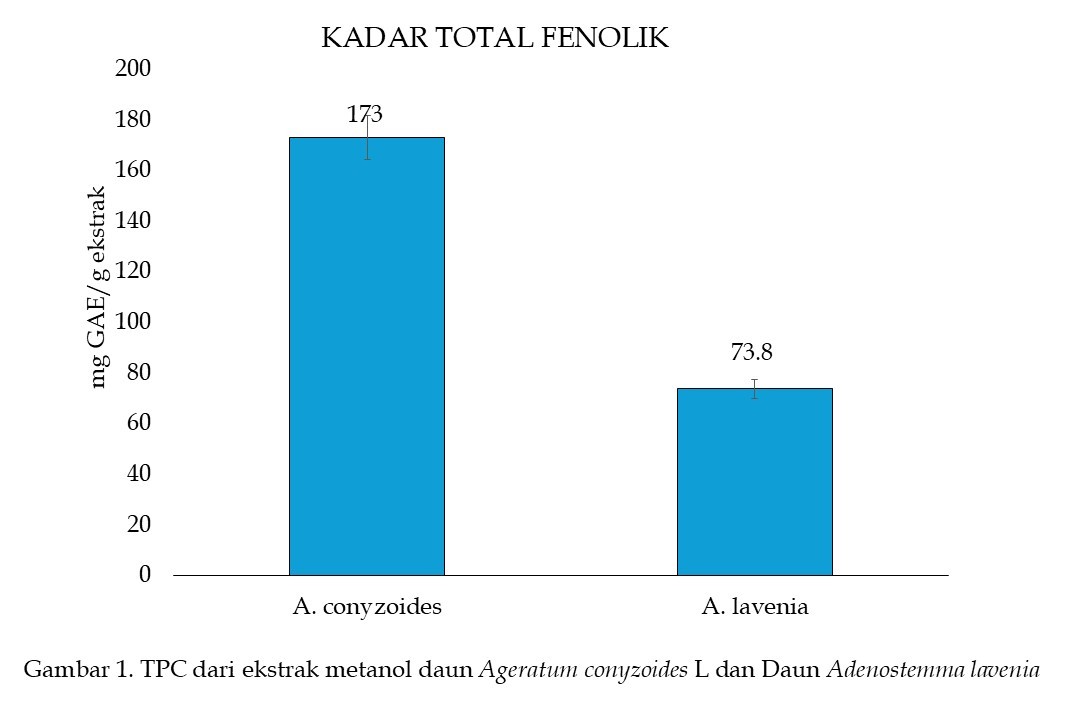
Ageratum conyzoides L. and Adenostemma lavenia are known to contain bioactive compounds with potential therapeutic properties. This study aimed to determine the phenolic and flavonoid contents, as well as the toxicity of leaf extracts from both species against Artemia salina larvae. The extraction process was carried out using methanol as a solvent. Phenolic content was measured using the Folin-Ciocalteu method, while flavonoid content was determined through a colorimetric method using aluminum chloride (AlCl₃) reagent. Toxicity testing was performed using the Brine Shrimp Lethality Test (BSLT) method. The results showed that the methanolic extract of Ageratum conyzoides L. contained 173 mg GAE/g extract of phenolics and 55.45 mg QE/g extract of flavonoids, which were higher than those found in Adenostemma lavenia, with 73.8 mg GAE/g extract of phenolics and 6.33 mg QE/g extract of flavonoids. Toxicity test results analyzed using probit analysis revealed LC₅₀ values of 43.17 μg/mL for Ageratum conyzoides L. extract and 208.07 μg/mL for Adenostemma lavenia extract, indicating that both are toxic. Based on these findings, it can be concluded that Ageratum conyzoides L. possesses greater potential as a source of bioactive compounds, as indicated by its higher toxic activity. Both plants are considered worthy of further investigation as potential anticancer agents.
References
Ahmad, I., & Ibrahim, A. (2015). Bioaktivitas ekstrak metanol dan fraksi n-heksana daun sungkai (peronema canescens jack) terhadap larva udang (artemia salina leach). Jurnal Sains dan Kesehatan, 1(3), 114-119.
Akhtar, N., & Mirza, B. (2018). Phytochemical analysis and comprehensive evaluation of antimicrobial and antioxidant properties of 61 medicinal plant species. Arabian journal of chemistry, 11(8), 1223-1235.
Batubara, I., & Prastya, M. E. (2020, November). Potensi tanaman rempah dan obat tradisional indonesia sebagai sumber bahan pangan fungsional. In Seminar Nasional Lahan Suboptimal (No. 1, pp. 24-38).
Batubara, I., Astuti, R. I., Prastya, M. E., Ilmiawati, A., Maeda, M., Suzuki, M.,& Takemori, H. (2020). The antiaging effect of active fractions and ent-11α-hydroxy-15-oxo-kaur-16-en-19-oic acid isolated from Adenostemma lavenia (L.) O. Kuntze at the cellular level. Antioxidants, 9(8), 719.
Dewi, S. R., Argo, B. D., & Ulya, N. (2018). Kandungan flavonoid dan aktivitas antioksidan ekstrak Pleurotus ostreatus. Rona Teknik Pertanian, 11(1), 1-10.
Fauzan, A., Praseptiangga, D., Hartanto, R., & Pujiasmanto, B. (2018). Characterization of the chemical composition of Adenostemma lavenia (L.) Kuntze and Adenostemma platyphyllum Cass. In IOP Conference Series: Earth and Environmental Science (Vol. 102, No. 1, p. 012029). IOP Publishing.
Harefa, S. K., Zega, U., & Bago, A. S. (2022). Pemanfaatan Daun Bandotan (Ageratum Conyzoides L.) Sebagai Obat Tradisional di Desa Bawoza’ua Kecamatan Telukdalam Kabupaten Nias Selatan. Tunas: Jurnal Pendidikan Biologi, 3(1), 14-24.
Indriaty, I., Djufri, D., Ginting, B., & Hasballah, K. (2023). Phytochemical screening, phenolic and flavonoid content, and antioxidant activity of Rhizophoraceae methanol extracts from Langsa, Aceh, Indonesia. Biodiversitas Journal of Biological Diversity, 24(5).
Katuuk, R. H., Wanget, S. A., & Tumewu, P. (2018). Pengaruh perbedaan ketinggian tempat terhadap kandungan metabolit sekunder pada gulma babadotan (Ageratum conyzoides L.). In Cocos (Vol. 10, No. 6).
Kurniawan, H., & Ropiqa, M. (2021). Uji toksisitas ekstrak etanol daun ekor kucing (Acalypha hispida Burm. f.) dengan metode Brine Shrimp Lethality Test (BSLT). Journal Syifa Sciences and Clinical Research (JSSCR), 3(2), 52-62.
Melissa, M. E. L. I. S. S. A., & Muchtaridi, M. (2017). Senyawa aktif dan manfaat farmakologis Ageratum conyzoides. Farmaka, 15(1), 200-212.
Meyer, H. N. 1982. Brine Shrimp Lethality Test. Med. Plant Research. 45(5), 31-34.
Patel, F. R., Modi, N. R., Modi, N. R., & Student, P. (2021). Antioxidant activity and FTIR analysis of Ageratum conyzoides L. International Journal of Botany Studies, 6(5), 1152-1161.
Phuyal, N., Jha, P. K., Raturi, P. P., & Rajbhandary, S. (2020). Total phenolic, flavonoid contents, and antioxidant activities of fruit, seed, and bark extracts of Zanthoxylum armatum DC. The Scientific World Journal, 2020(1), 8780704.
Riza, M., Afrinaldi., Ari, D.N., (2015). Kandungan Total Fenol dan Aktivitas Antioksidan Ekstrak Air Daun Kersen (Muntingia calabura L.). Jurnal Kedokteran Yarsi. 23: 187-196.
Rizky, A.A. & Dahlia, A. A.. (2014). Penetapan kadar flavonoid total dari ekstrak etanolik daun benalu mangga (dendrophthoe pentandra 1. miq). Jurnal Fitofarmaka Indonesia, I(1).
Rossa, A., Daulay, A. S., Ridwanto, R., & Rahayu, Y. P. (2023). Aktivitas antioksidan dan uji toksisitas ekstrak kulit batang kayu raru (Cotylelobium lanceolatum Craib) dengan menggunkan metode DPPH dan metode BSLT. Journal of Pharmaceutical and Sciences, 339-352.
Scheuer, J.S. 1994. Produk Alami Lautan. IKIP Semarang Press, Semarang.
Widowati, E. W., & Adihimawati, M. (2019). Penentuan Aktivitas Antikanker Fraksi Etil Asetat Daun Bandotan (Ageratum conyzoides linn.) Terhadap Cell Line Kanker Kolon WiDr. ALKIMIA: Jurnal Ilmu Kimia dan Terapan, 3(2), 33-40.
Zebua, N. F., Fujiko, M., Dachi, K., Nerdy, N., & Septama, A. W. (2024). Antibacterial, antioxidant and total flavonoid of Adenostemma lavenia (L.). Jurnal Natural, 24(2), 73-81.