Documentation of Wild Edible Fruits in Palangka Raya City
Dokumentasi Buah Musiman Lokal di Area Urban Kota Palangkaraya
Abstract
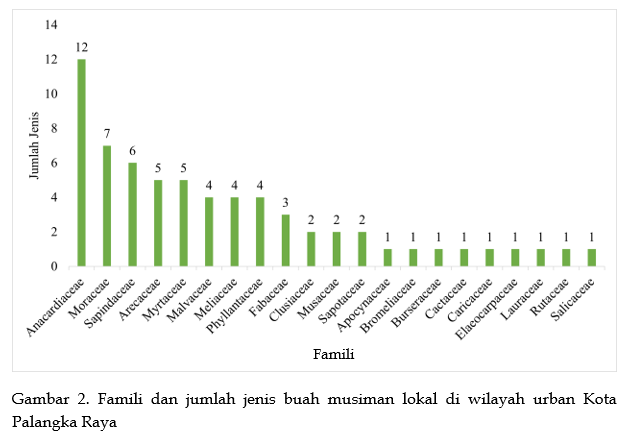
Kalimantan Island is one of the regions with high diversity of wild edible fruit plants that are utilized by both local and urban communities as food resources, particularly as sources of vitamins. This study aimed to document the diversity of local seasonal fruits traded in the urban area of Palangka Raya City. Data were collected through observation and recording at traditional markets, seasonal vendors, and online marketplaces (social media) in Palangka Raya City during the period from November 2022 to August 2024, with species identification based on morphological characteristics and verified using botanical literature and online plant databases. A total of 65 species of local seasonal fruits, belonging to 21 plant families and 35 genera, were documented. The results indicate that local seasonal fruits remain highly consumed and have considerable economic value during their fruiting seasons. The data generated in this study provide a baseline for the conservation of local seasonal fruits, the strengthening of local food security, and the monitoring of phenological dynamics and the impacts of climate change in urban areas.
References
Bajgai, R. C., Bajgai, Y., & Johnson, S. B. (2023). The presence of wild edible plants and determinants influencing their harvest, consumption, and conservation in South Eastern Bhutan. PLOS ONE, 18(10), e0285936. https://doi.org/10.1371/journal.pone.0285936
Chotimah, H. E. N. C., Kresnatita, S., & Miranda, Y. (2013). Ethnobotanical study and nutrient content of local vegetables consumed in Central Kalimantan, Indonesia. Biodiversitas: Journal of Biological Diversity, 14(2), 106–111. https://doi.org/10.13057/biodiv/d140209
Cunningham, A. B., & Shackleton, C. M. (2004). Use of fruits and seeds from indigenous and naturalised plant species. In M. Lawes, H. Eeley, C. M. Shackleton, & B. Geach (Eds.), Indigenous forests and woodlands in South Africa: Policy, people and practice (pp. 603–626). University of KwaZulu-Natal Press.
De Beer, J. H., & McDermott, M. J. (1996). The economic value of non-timber forest products in Southeast Asia (2nd ed.). Netherlands Committee for IUCN.
Duguma, H. T. (2020). Wild edible plant nutritional contribution and consumer perception in Ethiopia. International Journal of Food Science, 2020, Article 2958623. https://doi.org/10.1155/2020/2958623
Dunham, A., Razafindratsima, O., Rakotonirina, P., & Wright, P. (2018). Fruiting phenology is linked to rainfall variability in a tropical rain forest. Biotropica, 50. https://doi.org/10.1111/btp.12564
Gaveau, D. L. A., Locatelli, B., Salim, M. A., Husnayaen, Manurung, T., Descals, A., Angelsen, A., Meijaard, E., & Sheil, D. (2022). Slowing deforestation in Indonesia follows declining oil palm expansion and lower oil prices. PLOS ONE, 17(3), e0266178. https://doi.org/10.1371/journal.pone.0266178
Gaveau, D. L. A., Santos, L., Locatelli, B., Salim, M. A., Husnayaen, Heatubun, C., Meijaard, E., & Sheil, D. (2021). Forest loss in Indonesian New Guinea (2001–2019): Trends, drivers and outlook. Biological Conservation, 261, 109225. https://doi.org/10.1016/j.biocon.2021.109225
Gaveau, D. L. A., Sheil, D., Husnayaen, Salim, M. A., Arjasakusuma, S., Ancrenaz, M., Pacheco, P., & Meijaard, E. (2016). Rapid conversions and avoided deforestation: Examining four decades of industrial plantation expansion in Borneo. Scientific Reports, 6, Article 32017. https://doi.org/10.1038/srep32017
Hendaru, I., Hidayat, Y., & Ramdhani, M. (2018). Karakter morfologi tujuh aksesi pisang dari Maluku Utara. Buletin Plasma Nutfah, 23(1), 13–22. https://doi.org/10.21082/blpn.v23n1.2017.p13-22
Hickey, G. M., Pouliot, M., Smith-Hall, C., Wunder, S., & Nielsen, M. R. (2016). Quantifying the economic contribution of wild food harvests to rural livelihoods: A global-comparative analysis. Food Policy, 62, 122–132. https://doi.org/10.1016/j.foodpol.2016.06.001
Irawan, D., Wijaya, C., Limin, S., Hashidoko, Y., Osaki, M., & Kulu, I. (2006). Ethnobotanical study and nutrient potency of local traditional vegetables in Central Kalimantan. Tropics, 15, 441. https://doi.org/10.3759/tropics.15.441
Khan, M. P. Z., Ahmad, M., Zafar, M., Sultana, S., Ali, M. I., & Sun, H. (2015). Ethnomedicinal uses of edible wild fruits (EWFs) in Swat Valley, Northern Pakistan. Journal of Ethnopharmacology, 173, 191–203. https://doi.org/10.1016/j.jep.2015.07.029
Lestari, R. W., Rizki, M., Aziz, F., Fatiqin, A., & Irmawan, M. (2024). Catatan tamang mangkinang (Elaeocarpus glaber Blume) di Kalimantan Tengah. Bioscied: Journal of Biological Science and Education, 5, 53–64.
Lestariningsih, N., Jalil, M., Ayatusa’adah, & Nirmalasari, R. (2023). Ethnomedicine exploration of medicinal plants in Dayak Bakumpai and Ngaju tribes, Central Kalimantan, Indonesia. Biodiversitas, 24, 1163–1174. https://doi.org/10.13057/biodiv/d240257
MacKinnon, K. T. C. (1990). Biogeographical evolution of the Malay Archipelago [Review of the book Biogeographical evolution of the Malay Archipelago, ed. T. C. Whitmore]. Journal of Tropical Ecology, 6(1), 122–123. https://doi.org/10.1017/S0266467400004156
Mahapatra, A., & Panda, P. (2012). Wild edible fruit diversity and its significance in the livelihood of indigenous tribals: Evidence from Eastern India. Food Security, 4(2), 219–234. https://doi.org/10.1007/s12571-012-0186-z
Margono, B. A., Potapov, P. V., Turubanova, S., Stolle, F., & Hansen, M. C. (2014). Primary forest cover loss in Indonesia over 2000–2012. Nature Climate Change, 4(8), 730–735. https://doi.org/10.1038/nclimate2277
Navia, Z. I., Suwardi, A. B., & Nuraini. (2021). The importance of tropical edible fruit plants for tribal communities in East Aceh Region, Indonesia. IOP Conference Series: Earth and Environmental Science, 637(1), 012003. https://doi.org/10.1088/1755-1315/637/1/012003
Neneng, L., Naibaho, F., Rahman, S., Septya, L., Panjaitan, D., Lestari, R. W., Irsyam, A. S. D. P., Noraini, & Norwahyunie, N. (2025). Botanical survey of ethnomedicines in Dayak sub-ethnic groups, Ot Danum and Tomum in Central Kalimantan, Indonesia. Biodiversitas: Journal of Biological Diversity, 26, 458–469. https://doi.org/10.13057/biodiv/d260145
Neneng, L., Pujirahadju, A., Ferayani, F., & Widayat, T. (2020). Anti-tumor potential ethnomedicinal plants from Dayak tribes in Central Kalimantan. Biosaintifika, 12(3), 422–430. https://doi.org/10.15294/biosaintifika.v12i3.23671
Plants of the World Online. (2025). Plants of the World Online. Royal Botanic Gardens, Kew. Retrieved October 2025, from https://powo.science.kew.org/
Rahayu, Y. Y. S., Sujarwo, W., Irsyam, A. S. D., Dwiartama, A., & Rosleine, D. (2024). Exploring unconventional food plants used by local communities in a rural area of West Java, Indonesia: Ethnobotanical assessment, use trends, and potential for improved nutrition. Journal of Ethnobiology and Ethnomedicine, 20(1), 68. https://doi.org/10.1186/s13002-024-00710-y
Sardeshpande, M., & Shackleton, C. (2019). Wild edible fruits: A systematic review of an under-researched multifunctional NTFP (non-timber forest product). Forests, 10(6), 467. https://doi.org/10.3390/f10060467
Schunko, C., Li, X., Klappoth, B., Lesi, F., Porcher, V., Porcuna-Ferrer, A., & Reyes-García, V. (2022). Local communities’ perceptions of wild edible plant and mushroom change: A systematic review. Global Food Security, 32, 100601. https://doi.org/10.1016/j.gfs.2021.100601
Shackleton, C. (2011). Tropical forestry. Springer. https://www.springer.com/series/5439
Shava, S. (2005). Research on indigenous knowledge and its application: A case of wild food plants of Zimbabwe. Southern African Journal of Environmental Education, 22, 73–86.
Sunariyati, S., Purnama, A., & Agnestisia, R. (2023). Ethnobotanical knowledge of Dayak Ngaju in utilizing plant species to locate gold mining in Sei Riang Village, Central Kalimantan, Indonesia. Biodiversitas: Journal of Biological Diversity, 24, 4145–4150. https://doi.org/10.13057/biodiv/d240753
Suwardi, A. B., Baihaqi, B., & Harmawan, T. (2025). Diversity, utilization, and sustainable management of wild edible fruit plants in agroforestry systems: A case study in Central Kalimantan, Indonesia. Agroforestry Systems, 99, 1–15. https://doi.org/10.1007/s10457-025-01165-0
Suwardi, A. B., Syamsuardi, S., Mukhtar, E., & Nurainas, N. (2023). Ethnobotany and conservation of wild edible fruits in Sumatra: A case study in Pesisir Selatan, West Sumatra, Indonesia. The Philippine Journal of Science, 152, 1769–1784. https://doi.org/10.56899/152.05.19
Triyanto, A., Purnamasari, F., Paramita, F. S., Wicaksono, F. R., Ramadhan, F. A., Budiharta, S., Saensouk, S., & Setyawan, A. D. (2024). Ethnobotany of wild edible plants used by local communities in three districts along the Upper Bengawan Solo River, Central Java, Indonesia. Biodiversitas, 25(4), 1596–1605. https://doi.org/10.13057/biodiv/d250428
Van Steenis, C. G. G. J. (1950). The delimitation of Malaysia and its main plant geographical divisions. Flora Malesiana, Series I, 1, lxx–lxxv.