Physiological Responses and Survival of Prospective Nile Tilapia (Oreochromis niloticus) Broodstock Anesthetized with Clove Oil (Syzygium aromaticum) at Different Stocking Densities During Simulated Transportation
Abstract
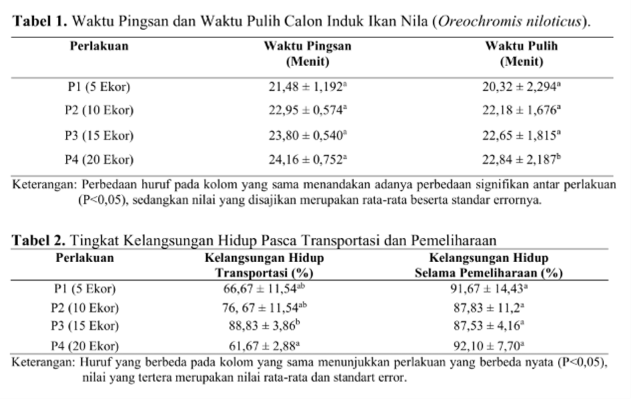
Nile tilapia (Oreochromis niloticus) is one of the most economically important freshwater aquaculture species and is highly susceptible to stress during transportation, making the use of anesthetics essential to improve survival. This study aimed to evaluate the physiological responses and survival of prospective Nile tilapia broodstock at different stocking densities following clove oil (Syzygium aromaticum) anesthesia during simulated transportation. The experiment employed a completely randomized design (CRD) consisting of four stocking density treatments, each with three replicates. The observed parameters included induction time, recovery time, oxygen consumption rate, survival rate, and water quality. The results showed that the longest induction time was recorded in treatment P4 (20 fish), averaging 24.16 minutes, whereas the shortest induction time occurred in treatment P1 (5 fish), averaging 21.48 minutes. Numerically, induction time tended to increase with increasing stocking density. Stocking density significantly influenced the behavioral responses of prospective Nile tilapia broodstock during simulated transportation under clove oil anesthesia. The highest post-transport survival rate was observed in treatment P3 (15 fish), reaching 88.83%, while the lowest survival rate was recorded in treatment P4 (20 fish), at 61.67%.
References
Abdel-Tawwab, M., & El-Araby, D. A. (2021). Effects Of Stocking Density On Growth Performance, Physiological Responses, And Oxidative Stress Of Nile Tilapia (Oreochromis Niloticus). Aquaculture, 531, 735–742
Aliyah, R. S. (2017). Rekayasa Produksi Ikan Nila Salin Untuk Perairan Payau Di Wilayah Pesisir. Jurnal Rekayasa Lingkungan. Jakarta. Vol. 10, No. 1.
Aliyas, A., Putri, I., Arifudin, A. (2021). Pengaruh Dosis Yang Berbeda Menggunakan Minyak Cengkeh (Eugenia Aromatic) Terhadap Kelangsungan Hidup Benih Ikan Nila (Oreochromis Niloticus). Jago Tolis: Jurnal Agrokompleks Tolis, 1(1), 23-26. Andriyani, Y. (2018). Budidaya Ikan Nila. Yogyakarta: Cv. Budi Utama. Anggraini.
Anggraini, S. Y., Esti, H., & Tutik, K. (2017). Toksisitas Dan Kemampuan Anestetik Minyak Cengkeh (Syzygium Aromaticum) Terhadap Benih Ikan Pelangi Merah (Glossolepis Incisus). Jurnal Ilmu Perikanan Dan Sumberdaya Perairan, 2(1).
Badan Standardisasi Nasional. (2006). Sni 06-2387-2006: Minyak Daun Cengkeh. Jakarta: Badan Standardisasi Nasional.
Bolasina, S., Tagawa, M., Yamashita, Y., & Tanaka, M. (2016). Effects Of Stocking Density On Stress Response And Oxygen Consumption Of Fish. Aquaculture Research, 47(4), 1226–1235.
Boyd, C. E. (2012). Water Quality: An Introduction. Springer, New York.
Boyd, C. E. (2015). Water Quality: An Introduction. Springer, New Yorki
Cao, J., Wang, Q., Qiu, W., Mei, J., & Xie, J. (2021). Transport And Recovery Of Turbot Sedated With Ms-222 And Eugenol: Effects On Intermediary Metabolism And Osmoregulation. Animals, 11, 2228
Effendi, H., Wardiatno, Y., & Krisanti, M. (2016). Kualitas Air: Teori Dan Aplikasi Dalam Pengelolaan Sumber Daya Perairan. Kanisius, Yogyakarta.
El-Sayed, A. F. M. (2020). Tilapia Culture. Academic Press.
Hastuti, S., Rahardjo, S., & Widodo, M. S. (2018). Pengaruh Kepadatan Tebar Terhadap Stres Dan Kebutuhan Oksigen Ikan. Jurnal Akuakultur Indonesia, 17(2), 101–109.
Kheawfu, K., Pikulkaew, S., Wellendorph, P., Jørgensen, L. V. G., Rades, T., Müllertz, A., & Okonogi, S. (2022). Elucidating Pathway And Anesthetic Mechanism Of Action Of Clove Oil Nanoformulations In Fish. Pharmaceutics, 14(5), 919. Https://Doi.Org/10.3390/Pharmaceutics14050919
Liao, I. C., & Huang, H. J. 1975. Studies On The Respiration Of Economic Prawns In Taiwan. I. Oxygen Consumption And Lethal Dissolved Oxygen Of Egg Up To Young Prawn Of Penaeus Monodon Fab. Journal Of The Fisheries Society Of Taiwan, 4(1): 33–50.
Martins, C. I. M., Galhardo, L., Noble, C., Damsgård, B., Spedicato, M. T., Zupa, W., Beauchaud, M., Kulczykowska, E., Massabuau, J. C., Carter, T., Rey Planellas, S., & Kristiansen, T. (2012). Behavioural Indicators Of Welfare In Farmed Fish. Fish Physiology And Biochemistry, 38(1), 17–41.
Muchlisin, Z. A., Afrido, F., Murda, T., Fadli, N., Muhammadar, A. A., Jalil, Z., & Yulvizar, C. (2016). The Effectiveness Of Experimental Diet With Varying Levels Of Papain On The Growth Performance, Survival Rate And Feed Utilization Of Keureling Fish (Tor Tambra). Biosaintifika: Journal Of Biology & Biology Education, 8(2), 172–177.
Ross, L. G., & Ross, B. (2008). Anaesthetic And Sedative Techniques For Aquatic Animals. 3rd Ed. Blackwell Publishing.
Saskia Y, Esti H, Tutik K, (2017). Toksisitas Dan Kemampuan Anestetik Minyak Cengkeh (Sygnium Aromaticum) Terhadap Benih Ikan Pelangi Merah (Glossolepisincisus).Jurnalilmuperikanandansumberdayaperairan.2(1).
Wijayanti, I. (2011). Pengaruh Temperatur Terhadap Kondisi Anestesi Pada Bawal Tawar (Colossoma Macropomum) Dan Lobster Tawar (Cherax Quadricarinatus).Prosidingseminarnasional.Pengembanganpulau-Pulau Kecil.